
Edge AI Mission System
Reference platform · Defence & mission-critical
Vision, speech, and multimodal AI running entirely on-device. Fanless, battery-powered, offline-first.
AI that keeps running when connectivity doesn’t
Missions generate more sensor data than any link can carry back. When the connection is degraded, denied or simply undesirable, intelligence has to be extracted where it is produced. Built on Intel® Core™ Ultra Series 3 Processors, the platform sustains concurrent CPU, GPU and NPU workloads in a handheld, fanless enclosure - on battery, in the field.
Intel® Core™ Ultra Series 3 Processors
CPU, GPU and NPU on a COM Express Type 6 module, mounted on a device-specific carrier board.
Concurrent AI workloads
Vision, language and speech pipelines running in parallel, entirely on-device.
Fanless by construction
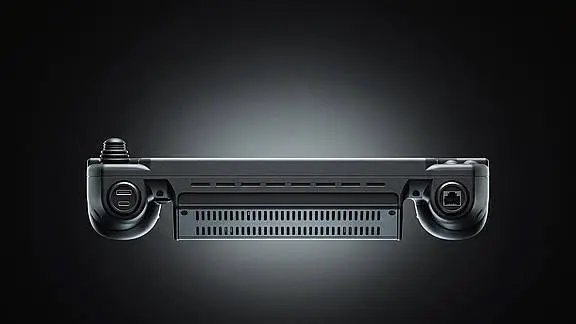
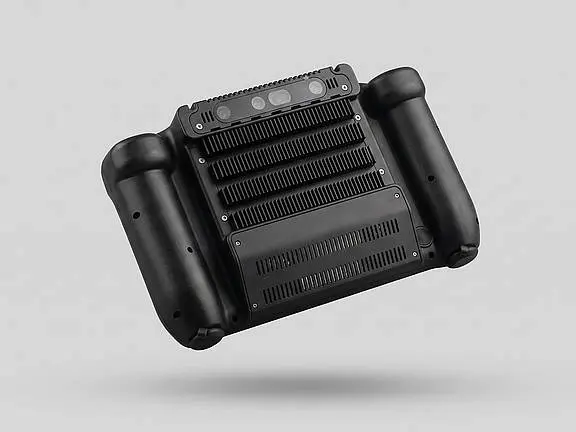
Fully passive thermal design with sealed housing and external heatsink. No moving parts, no intake.
Container-native software
Ubuntu LTS or Clea OS, containerd and K3s, with GPU and NPU passthrough into your containers.
Field connectivity, on your terms
The platform carries a full set of wired and wireless interfaces with expansion paths for additional radios, so integrators can shape the communications stack around the mission profile rather than around the hardware.
Removable battery + USB-C power
M.2 slots - Wi-Fi 6E / 7 and LTE
A 10.1” display built for sunlight and gloves
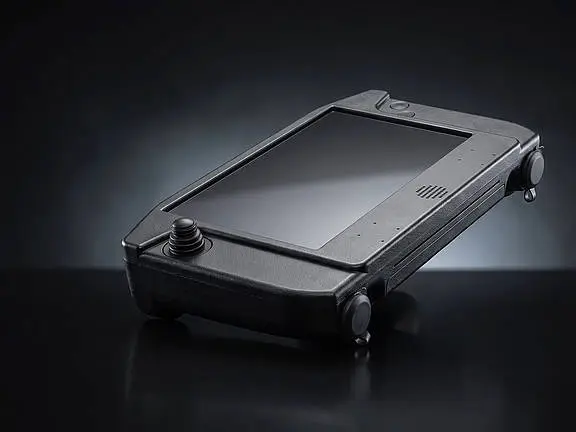
The operator interface is the mission interface. The display, touch layer and cover glass are specified for outdoor readability and gloved operation, with dual joystick control and mission pushbuttons integrated directly into the enclosure.
- Resolution 1920 × 1200, 16:10 aspect ratio
- Projected capacitive multi-touch, glove-capable
- Sun-readable brightness
- Chemically strengthened cover glass, optical bonding
- Integrated joystick and mission pushbuttons
Applications and use cases
Three roles where the compute has to travel with the operator, and the answer has to arrive before the connection does.
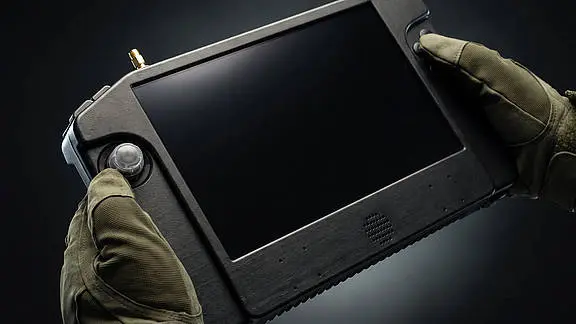
Dismounted soldier & tactical C2
The operator carries the compute. Detection and tracking overlays render on the handheld, and the mission picture holds when the link does not.
UGV / UAS control
A control station that fits in two hands: joystick and mission buttons for the vehicle, on-device vision for what its sensors send back.
ISR & sensor-fusion front-ends
Depth and RGB streams fused and interpreted where they are captured, so actionable information can be generated locally without requiring every raw stream to be sent upstream.
Software that stays under your control
The platform boots Ubuntu LTS or Clea OS, SECO's Yocto-based operating system. AI workloads for vision and multimodal interaction run as containers on top of it.
Applications run under container with K3s orchestration, and get direct GPU and NPU access from inside the container — so your own models and pipelines run with direct access to the accelerators. A local registry supports air-gapped deployment.
Clea OS brings secure boot chains, controlled OTA updates, system integrity enforcement and long-term maintainability, aligned with the Cyber Resilience Act (CRA).
A European designer with a US defence footprint
SECO designs and manufactures end-to-end embedded and mission-critical systems: 45+ years, 850+ people with over 30% in R&D, 10 R&D centres and 5 production plants across 3 countries. SECO USA (Rockville, MD) has direct experience designing and delivering battery-operated handheld controllers.
AS9100D · ITAR registered
SECO USA is certified for design and production of electronic systems. CAGE code 8Z220.
ISO 9001
Construction, realization and technical assistance of electronic boards and embedded systems.
ISO 27001
IT and physical infrastructure management across design, production and support.
Design to MIL-STD and DO standards
SECO can support MIL-STD-810, MIL-STD-461, DO-254 and DO-178 design requirements in the product-specific design.
Where the platform is today
The reference platform exists as functional hardware. Reference kits can be made available for evaluation under a technical engagement.
It is not an off-the-shelf catalog product: it is a reference design — functional hardware plus the engineering package behind it — meant to let you evaluate the architecture and then move into a qualified, application-specific product program with SECO, instead of starting a handheld design from scratch.
Start from a platform that already works
Bring us the mission profile. We bring a working handheld, the engineering behind it, and a western supply chain that can carry it into production.